Compromised eMudhra Intermediate Certificates: Operational Risk for Managed Service Providers and Cloud Environments
Published: October 21, 2026
Author: Storm Cloud Security
On October 17–20, 2026, the cybersecurity community identified a severe failure in the Web public key infrastructure (WebPKI). Eight intermediate certificate authority (CA) certificates issued by India-based eMudhra Limited (operating under the emSign brand) were found to have private keys with only 3–8 bits of entropy. These keys, generated in April 2025, are trivially recoverable. Because the intermediates chain to roots trusted by major browser and operating system programs (including emSign Root TLS CA – G3 and cross-signs under Sectigo), possession of the keys enables an attacker to issue certificates for any domain that many systems will accept as valid.
Major browsers and root programs blocked the intermediates within hours using rapid revocation mechanisms (Chrome CRLSets, Mozilla OneCRL, and equivalents from Apple and Microsoft). eMudhra revoked the certificates. Certificate Transparency logs have shown no confirmed malicious issuance to date. Exploitation requires an active adversary-in-the-middle (MITM) position. The residual and longer-term risk lies outside the browser ecosystem.
This incident is not primarily a browser problem. It is an operational and supply-chain problem for organizations that manage large numbers of non-browser systems—precisely the environment managed service providers (MSPs) operate in.
Why This Hits MSPs Harder Than Most Organizations
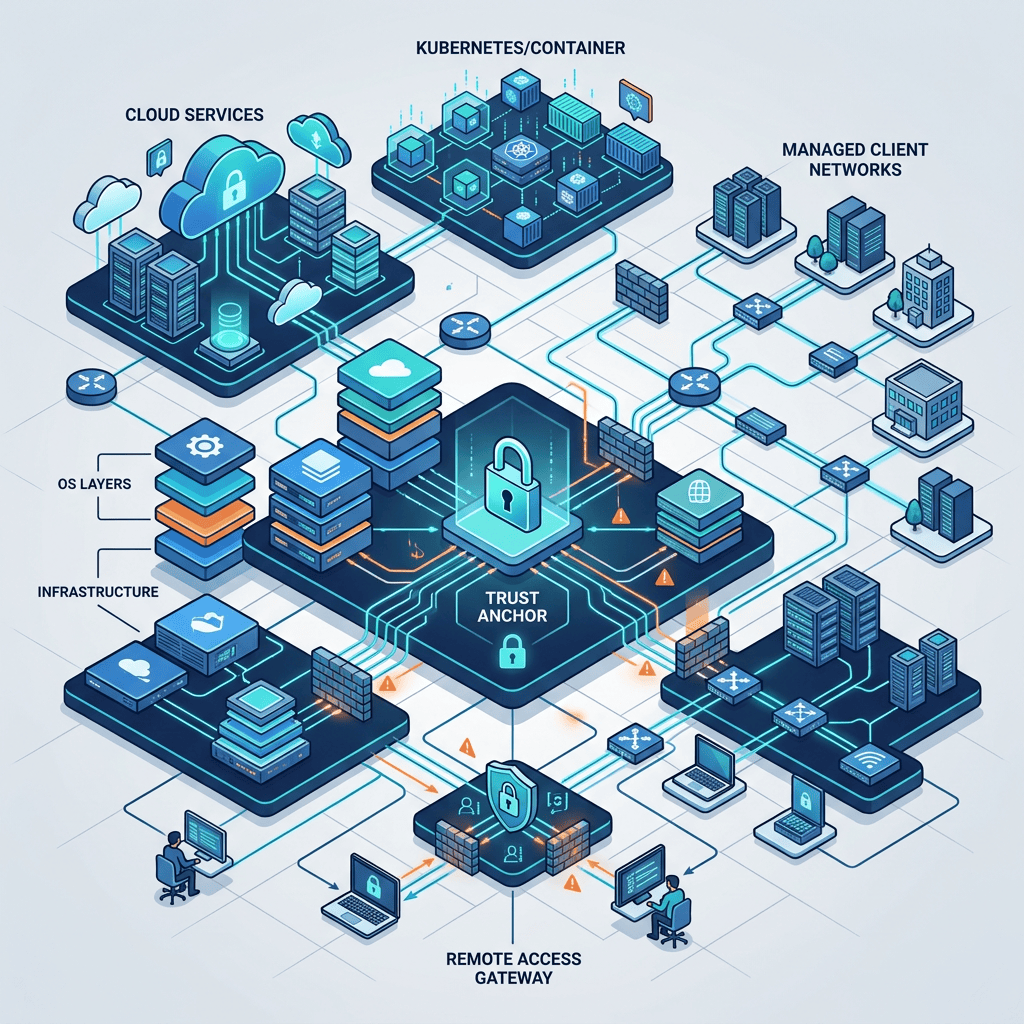
MSPs typically control or co-manage customer infrastructure across public cloud (AWS, Azure, GCP), hybrid environments, private clouds, containers, edge devices, and remote access tooling. Unlike a single enterprise that can focus on its own endpoints and a handful of critical applications, an MSP must remediate across heterogeneous fleets belonging to multiple clients.
Key exposure areas include:
- Operating system trust stores — Linux distributions rely on the
ca-certificatespackage (or equivalent). Updated packages are available or rolling out for Ubuntu, Debian, Fedora/RHEL-family, Alpine, and others. Until applied, systems continue to trust chains that can be forged. - Container and Kubernetes environments — CA bundles are baked into images at build time. Patching the host OS is insufficient. Images must be rebuilt from updated base images and redeployed. The same applies to CI runners, build agents, and many serverless workloads.
- Language runtimes and application stacks — Python (
certifi), Go, Java, Node.js, Rust (webpki-roots/rustls), and others frequently ship or embed their own trust stores. These require separate updates and rebuilds. - Remote access, Zero Trust, and management tooling — VPN clients, Cloudflare Tunnel (
cloudflared), WARP/Cloudflare One clients, RMM agents, and similar tools perform TLS validation against public roots. Unpatched instances increase MITM exposure on management and client connectivity paths. Two of the compromised intermediates were also used for code signing, creating a secondary risk for software distribution channels that rely on those chains. - Long-tail and forgotten systems — Old VMs, abandoned container images, embedded/IoT gateways, and unmaintained CLI tools that vendors or internal teams ship with static CA bundles. These are common in multi-client MSP portfolios.
Major cloud providers are updating their own control planes and shared services. The customer-managed layer—where most MSP responsibility sits—requires deliberate action.
Practical Risk Assessment
The immediate risk is limited by two factors: rapid browser-level blocking and the absence of observed malicious use in CT logs. The practical residual risk is highest for systems that:
- Still trust the affected intermediates or their parent roots,
- Initiate outbound TLS connections (API calls, software updates, authentication, client portals, cloud provider endpoints), and
- Can be subjected to a network-positioned attacker (compromised client network, weak perimeter controls, malicious Wi-Fi, or more sophisticated interception).
In environments with strong network controls and limited external exposure, the window is narrower. In multi-tenant or client-site remote access scenarios typical of MSP operations, the exposure surface is larger until trust stores are updated.
Recommended Actions for MSPs
Treat this as a coordinated fleet-wide remediation rather than a single-system patch.
- Inventory trust dependencies
Identify hosts, containers, language runtimes, VPN/Zero Trust clients, RMM agents, and custom applications that perform public WebPKI validation. Prioritize systems with outbound connectivity or that handle client management traffic. - Update OS trust stores
Apply the latestca-certificates(or equivalent) packages across Linux distributions under management. Confirm Windows and macOS platform updates have propagated. Restart long-running services that load the trust store at startup. - Rebuild and redeploy containers and images
Update base images, rebuild application images, and redeploy. Do not assume host-level updates protect containerized workloads. - Update language and application packages
Refresh Pythoncertifi, Go, Java, Node.js, Rust crates, and any other bundled CA stores. Rebuild affected binaries and containers. Update Cloudflare Tunnel, WARP, and similar clients to the versions released for this incident. - Validate and monitor
After updates, test connectivity to critical external services. Monitor Certificate Transparency logs for unexpected certificates issued under the compromised intermediates. Watch for temporary breakage from sites still using affected chains (these will need reissuance). - Address the long tail
Flag systems that cannot be quickly updated (end-of-life distributions, embedded devices, vendor appliances with static bundles). Apply compensating controls—network segmentation, increased monitoring for anomalous certificates, or temporary restriction of outbound TLS—while longer-term replacement or isolation is planned. - Client communication
Provide clients with a clear scope statement, expected actions, and any temporary service impacts. Coordinate change windows where restarts or redeployments are required.
Supply Chain and Risk Management Context
Certificate authorities sit in the trust supply chain for virtually every TLS-protected connection. This incident illustrates a classic third-party risk: a single upstream provider’s key-generation failure created a broad impersonation capability. For organizations practicing Cybersecurity Supply Chain Risk Management (C-SCRM), it reinforces the need to:
- Maintain visibility into critical trust dependencies (root and intermediate programs, embedded CA bundles).
- Prefer systems and vendors that support rapid revocation or trust-store updates rather than static, infrequently refreshed bundles.
- Include public WebPKI failures in tabletop exercises and incident response planning, particularly for MSPs whose clients depend on continuous remote management and cloud connectivity.
- Evaluate whether high-value or high-sensitivity workloads should use certificate pinning, private CAs, or additional mutual authentication where operationally feasible.
Conclusion
The eMudhra intermediate certificate compromise is a reminder that WebPKI trust is only as strong as the weakest intermediate and the slowest system that still accepts it. Browsers responded quickly. The operational burden now falls on administrators—and especially on MSPs—who must systematically update trust stores, rebuild images, and close the long tail of unmanaged or infrequently patched systems.
Storm Cloud Security continues to track developments in certificate trust, supply-chain risk, and practical remediation for managed and hybrid environments. Organizations that treat trust-store hygiene as a recurring operational control rather than a one-time event will be better positioned for the next incident of this type.


Leave a Reply