Weeks like October 16–23, 2026, demonstrate why NIST SP 800-53 control SI-2 (Flaw Remediation) is foundational to system and information integrity. Multiple critical issues—ranging from unauthenticated remote code execution in widely deployed runtimes to trust-store compromises and actively exploited chains—emerged or saw confirmation of exploitation in a short window. Organizations that treat SI-2 as a living process rather than a checkbox are positioned to absorb this volume without systemic exposure.
What SI-2 Requires
Under NIST SP 800-53 Rev. 5, SI-2 requires organizations to:
- Identify, report, and correct system flaws;
- Test software and firmware updates related to flaw remediation for effectiveness and potential side effects before installation;
- Install security-relevant software and firmware updates within an organization-defined time period of their release; and
- Incorporate flaw remediation into the organizational configuration management process.
Related controls reinforce this intent, including RA-5 (Vulnerability Monitoring and Scanning) for identification, CM-3 (Configuration Change Control) and CM-6 (Configuration Settings) for disciplined deployment, CA-5 (Plan of Action and Milestones) for tracking deferred items, and SI-5 (Security Alerts, Advisories, and Directives) for timely awareness. Enhancements such as SI-2(2) (Automated Flaw Remediation Status) and SI-2(4) (Automated Patch Management Tools) further support consistent execution, particularly in moderate and high baselines.
The control’s discussion emphasizes that flaw remediation applies to all software and firmware, that prioritization should reflect risk factors (severity, exploitability, system criticality, and threat environment), and that the process must be trackable and verifiable through configuration management.
Meeting the Intent of SI-2
To satisfy the control’s intent—not merely its letter—organizations need more than a patching calendar. Core elements include:
- Continuous identification and reporting: Asset inventory (CM-8) combined with vulnerability scanning, vendor advisories, and threat intelligence feeds ensures flaws are discovered and escalated to designated personnel. Incomplete inventories are the most common failure point when runtime or trust-store issues appear.
- Risk-based prioritization and defined timelines: Organizations assign time periods based on severity, exposure, and mission impact (for example, shorter windows for internet-facing unauthenticated RCE versus internal medium issues). SI-2(3) supports measuring actual time-to-remediate against these benchmarks.
- Testing and controlled deployment: Updates are evaluated for effectiveness and side effects before broad installation, then executed under CM-3 change control with verification of the running configuration.
- Verification and residual risk management: Post-remediation validation confirms the flaw is corrected. Items that cannot be remediated within the defined period are documented in a Plan of Action and Milestones (CA-5) with compensating controls and owner accountability.
- Integration and automation: Flaw remediation is embedded in configuration management so actions are tracked, auditable, and repeatable. Automated status reporting (SI-2(2)) reduces reliance on manual checks during high-volume periods.
Implementing SI-2 Successfully During High-Velocity Weeks
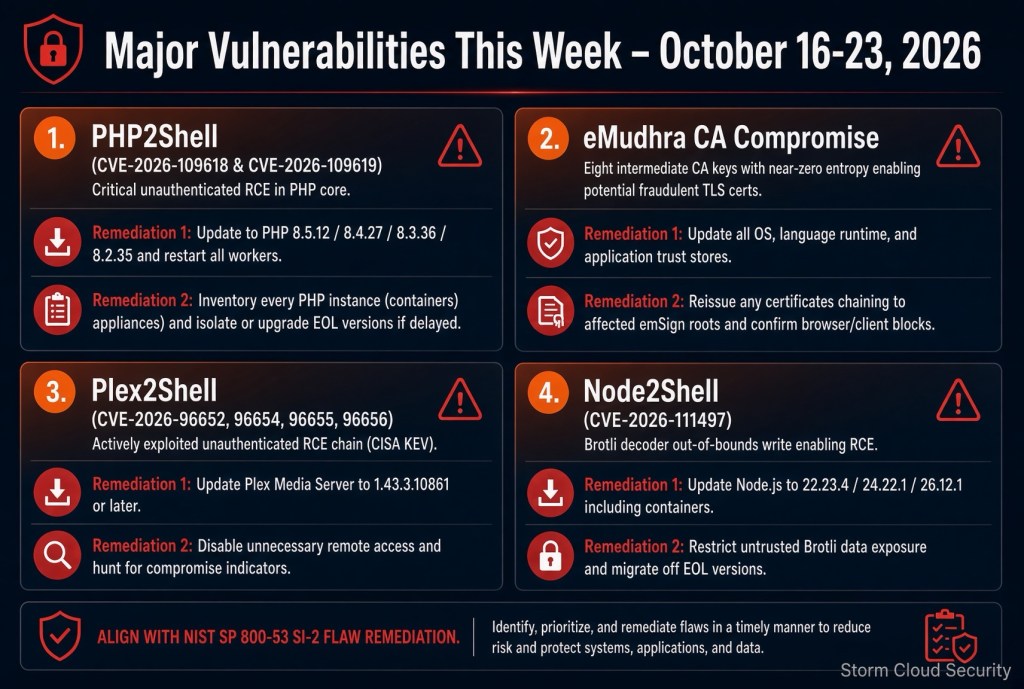
The October 16–23, 2026, period illustrated the practical demands of SI-2. Critical items included PHP2Shell (unauthenticated RCE in PHP core), the eMudhra intermediate CA key compromise (weak keys enabling potential fraudulent certificates), the actively exploited Plex2Shell chain (added to the CISA Known Exploited Vulnerabilities catalog), and Node2Shell (Brotli decoder issue with RCE potential). The following infographic summarizes these items and their high-level remediation steps, consistent with SI-2 prioritization:
Successful corporate implementation during such weeks rests on several operational practices:
- Pre-positioned inventory and ownership: Maintain an accurate, queryable inventory of runtimes (PHP, Node.js), media servers, certificate trust stores, and embedded components. Assign clear owners so identification does not stall when multiple advisories arrive simultaneously.
- Tiered response playbooks: Define severity-driven timelines in advance (for example, critical internet-facing RCE within hours to days; others per organizational risk tolerance). Activate compensating controls—network isolation, WAF rules, temporary configuration hardening, or reduced exposure—while testing and deploying patches.
- Coordinated change and verification: Route remediations through configuration management so testing, deployment, and post-install validation are recorded. Confirm the running version or configuration (not merely the package on disk) and restart services or rebuild containers as required.
- Residual risk tracking: Document any delayed items or end-of-life platforms in the POA&M with interim mitigations, target dates, and residual risk acceptance. This preserves auditability under CA-5 and SI-2.
- Automation and measurement: Leverage vulnerability management platforms and automated status checks (SI-2(2)) to scale visibility. Measure time-to-remediate to refine future benchmarks.
- Cross-functional readiness: Align security, operations, application owners, and change advisory boards so high-volume weeks do not create bottlenecks. Practice through tabletop exercises that simulate concurrent critical disclosures.
Organizations that embed these elements treat SI-2 as an operational capability rather than a compliance artifact. When multiple high-severity flaws surface in a single week, the control’s intent—timely, tested, verified, and managed correction of flaws—directly reduces exposure while preserving system integrity and audit readiness.
For assessors and implementers, evidence of effective SI-2 includes documented procedures, inventory artifacts, change records, verification results, POA&M entries for any residual items, and metrics on time-to-remediate. Weeks of elevated vulnerability activity simply stress-test whether those elements are real.


Leave a Reply